Keyhole (Laparoscopic) or Open Surgery for Children: A Parent's Guide
Keyhole surgery uses small cuts and a camera. Learn which children's operations can be done this way, its benefits and limits, and why the surgeon sometimes chooses open surgery.

What is keyhole surgery?
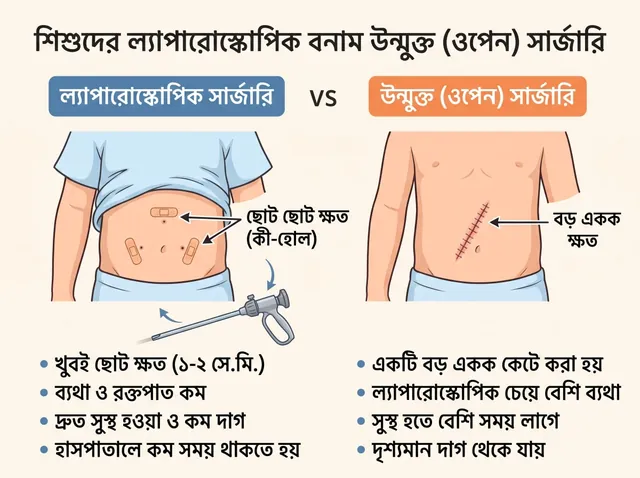
In laparoscopic (keyhole) surgery, the surgeon makes two or three small cuts, usually 3–5 mm in children, and passes a thin camera and fine instruments inside. The operation is watched on a screen. In open surgery, the surgeon works through one larger cut.
Which children's operations can be done by keyhole?
- Appendicectomy (removing an inflamed appendix)
- Some inguinal hernia repairs, especially when both sides need checking
- Finding and bringing down a testis that cannot be felt
- Gallbladder removal and some bowel operations
- Some ovarian cyst and kidney operations
Possible benefits
- Smaller scars.
- Often less pain in the first days.
- Often a quicker return to eating, playing and school.
- A good view of the whole tummy, which can help when the diagnosis is uncertain.
Limits
Keyhole surgery is not better for every child or every condition. Some operations are simpler, quicker or safer done open — for example many routine hernia repairs in babies through a tiny groin cut, or when there is a lot of inflammation or previous surgery. Sometimes an operation that starts by keyhole is changed to open during the procedure for safety; this is a sensible decision, not a failure.
Is it safe for small children?
With pediatric-sized instruments and an experienced anaesthetic team, keyhole surgery can be done in infants and children. The surgeon weighs your child's age, size and condition before recommending an approach.
What to ask your surgeon
- Which approach do you recommend for my child, and why?
- What is the expected recovery time?
- What are the risks of each approach for this condition?
Treatment at the chamber: Minimally Invasive (Laparoscopic) Surgery
Have concerns about your child's health? Consult Dr. Zannatul Ferdous Peu
SIBL Foundation Hospital, Panthapath — Saturday – Thursday: 3:00–9:00 PM
Emergency: 01991-150900 · SIBL Foundation Hospital 24/7 hotline
This page is for general education and is not a substitute for a medical consultation. Medical Disclaimer