
Testicular Torsion: Every Parent Should Know These Warning Signs
A sudden, severe pain in your son's groin is never something to ignore. It could be testicular torsion—a surgical emergency where every minute counts. Learn the critical warning signs and why you only have a few hours to save the testicle.

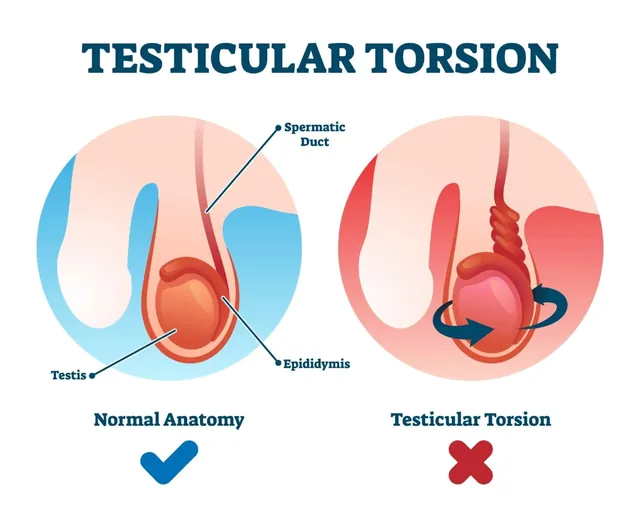
What Is Testicular Torsion?
Inside the scrotum, the testicles are attached to the body by a structure called the spermatic cord, which contains the blood vessels that supply oxygen and nutrients to the testicle. Testicular torsion occurs when the testicle rotates or twists on this cord, completely cutting off its own blood supply.
Without blood flow, the tissue of the testicle begins to die very quickly. While it can happen at any age, it is most common in newborn boys and during puberty (ages 12 to 18).
The "Golden Window" for Treatment
Testicular torsion is a true medical emergency. There is a strict 4 to 6-hour window from the moment the pain starts to surgically untwist the cord and save the testicle.
If surgery is performed within this timeframe, the testicle can be saved in nearly 90% to 100% of cases. After 12 hours, the chances of saving the testicle drop to around 20%, and after 24 hours, the testicle is almost always permanently damaged and must be removed.
Warning Signs You Must Never Ignore
Because teenagers are often embarrassed to talk about pain in their private areas, it is vital to teach your sons to tell you immediately if they experience any of these symptoms:
- Sudden, severe pain: This is the most common symptom. The pain hits instantly in one testicle or the general scrotal area. It can even wake a child out of a sound sleep.
- Swelling and redness: The scrotum on the affected side will quickly become swollen, red, or noticeably darker.
- Abdominal pain: Sometimes, the pain radiates upward into the lower belly. (Never assume lower belly pain is just a stomach ache without checking for other symptoms).
- Nausea and vomiting: The pain is often so intense that it makes the child feel sick to their stomach.
- Abnormal position: The affected testicle may sit noticeably higher in the scrotum than normal or rest at an unusual angle.
What Parents Should Do (And NOT Do)
DO go to the emergency room immediately. Do not wait for an appointment with your regular doctor. Head straight to a hospital with surgical facilities.
DO NOT wait to see if it "gets better." Torsion does not resolve on its own.
DO NOT give painkillers. Pain medication will not fix the lack of blood flow, but it might mask the symptoms and delay a proper diagnosis, wasting precious time.
What Does the Surgery Involve?
The surgery is straightforward but extremely time-sensitive. Under general anaesthesia, a paediatric surgeon makes a small incision in the scrotum, untwists the spermatic cord to restore blood flow, and then places a few small stitches to anchor the testicle to the inside of the scrotum (a procedure called orchiopexy). This prevents it from ever twisting again.
Usually, the surgeon will also anchor the healthy testicle on the other side as a preventative measure, since boys who experience torsion on one side are anatomically more prone to it on the other side as well.
Treatment at the chamber: Undescended Testis (Cryptorchidism)
Also searched as: testicular torsion symptoms, testicle twisted
Have concerns about your child's health? Consult Dr. Zannatul Ferdous Peu
SIBL Foundation Hospital, Panthapath — Saturday – Thursday: 3:00–9:00 PM
Emergency: 01991-150900 · SIBL Foundation Hospital 24/7 hotline
This page is for general education and is not a substitute for a medical consultation. Medical Disclaimer