My Son's Testicle Hasn't Come Down — Should I Be Worried?
One of the most common questions parents of newborn boys ask is about an empty scrotum. Here's what undescended testicles really mean, when to act, and why timing matters more than most parents realise.

What Is an Undescended Testicle?
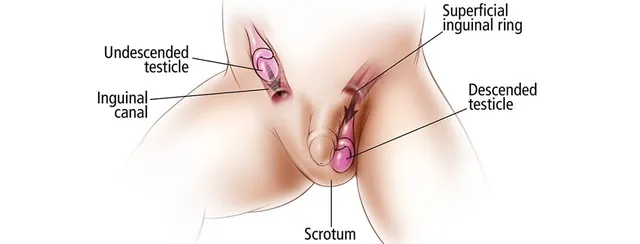
When a baby boy is developing in the womb, his testicles actually form inside the abdomen — near the kidneys. During the final weeks of pregnancy, they travel down through the groin and into the scrotum. In most boys this happens naturally before birth.
In some boys, one or both testicles don't complete that journey. The testicle stays somewhere along the route — in the abdomen, inside the groin canal, or just outside the scrotum. This is called an undescended testicle, or in medical terms, cryptorchidism.
It's more common than most parents expect. About 2–4% of full-term baby boys are born with it. In premature babies the number is much higher — up to 30–45% — because the testicles simply didn't have enough time to descend before birth.
The good news: in many cases the testicle descends on its own within the first few months of life. But if it hasn't come down by 6 months of age, it almost certainly won't do so on its own — and that's when surgery becomes necessary.
How Would I Know If My Son Has This?
The most obvious sign is an empty or flat-looking scrotum — either on one side or both. When you bathe your baby boy or change his nappy, you may notice the scrotum looks smaller or one side doesn't feel the same as the other.
Sometimes a testicle can be felt in the groin area but can't be pushed down into the scrotum. Other times it can't be felt at all — meaning it's sitting inside the abdomen and requires further investigation.
One important thing to understand: a "retractile" testicle is different. Some boys have a testicle that moves in and out of the scrotum — it comes down when warm and relaxed, and retracts when cold or stimulated. This is usually normal and often resolves on its own. The distinction requires a proper clinical examination by a paediatric surgeon to confirm.
Why Does It Need to Be Treated?
Fertility problems. The testicle needs to be in the scrotum because sperm production requires a temperature slightly lower than the body's core temperature. Inside the abdomen or groin, the testicle is too warm to develop properly. The longer it stays in the wrong place, the more damage accumulates. The earlier surgery is done, the better the fertility outcome.
Increased risk of testicular cancer. An undescended testicle has a higher lifetime risk of developing cancer. Bringing it down into the scrotum doesn't eliminate that risk entirely, but it places the testicle where it can be examined regularly — which is critical for early detection.
Testicular torsion. An undescended testicle is more likely to twist on its cord, cutting off blood supply. This is a surgical emergency. Sudden severe groin or abdominal pain in a boy with an undescended testicle must be treated immediately.
Associated hernia. The vast majority of boys with undescended testicles also have an inguinal hernia on the same side. Surgery addresses both at the same time.
Psychological impact. As boys grow older, an empty or abnormal-looking scrotum can become a source of distress. Early correction avoids this entirely.
When Should Surgery Be Done?
Current guidelines recommend surgery between 6 and 18 months of age — ideally around 12 months. This timing is based on strong evidence: the testicle's sperm-producing cells are most responsive to their correct environment during the first year of life.
Many families in Bangladesh present much later — sometimes when the child is 5, 8, or even older. This is often because the condition was dismissed as something that would "sort itself out." Surgery can still be done in older children, but the earlier it's done, the better the long-term outcome.
If your son is older than 6 months and the testicle has not descended — please don't wait any longer.
What Does the Surgery Involve?
The operation is called an orchiopexy. It is one of the most commonly performed paediatric surgical procedures and is very well established.
The surgery is performed under general anaesthesia. The surgeon makes a small incision in the groin, locates the testicle, frees it carefully, brings it down into the scrotum, and secures it there in a small pocket beneath the scrotal skin.
For testicles that cannot be felt — sitting somewhere inside the abdomen — a laparoscopic approach is used first. A tiny camera locates the testicle precisely, and the orchiopexy is completed either laparoscopically or in stages depending on what's found.
The surgery takes 30–60 minutes. Most children go home the same day. Recovery requires a few days of rest, limited activity for 2 weeks, and a follow-up visit to confirm everything has settled well.
What About Hormone Treatment?
Hormone therapy (hCG injections) was used in the past to try to stimulate descent without surgery. Current evidence does not support this as a primary treatment — the success rate for true undescended testicles is very low. Surgery remains the only reliable and recommended treatment.
What Parents Should Do Right Now
If your baby boy is under 6 months and testicles haven't come down — keep watching, but at the 6-month mark have a paediatric surgeon examine your son if descent hasn't occurred.
If your son is older than 6 months and the testicle is still absent from the scrotum — book an appointment now.
If your son ever complains of sudden pain in the groin or abdomen — treat it as an emergency and go directly to hospital. This could be testicular torsion, which must be treated within hours.
Families who prefer a woman doctor: female pediatric surgeon in Dhaka
Treatment at the chamber: Undescended Testis (Cryptorchidism)
Have concerns about your child's health? Consult Dr. Zannatul Ferdous Peu
SIBL Foundation Hospital, Panthapath — Saturday – Thursday: 3:00–9:00 PM
Emergency: 01991-150900 · SIBL Foundation Hospital 24/7 hotline
This page is for general education and is not a substitute for a medical consultation. Medical Disclaimer